
A question we hear from homeowners and renters along the lake all the time.
If your key turns but door won’t open in Lakeshore Toronto, don’t force it: a key that rotates without releasing the door almost always means a broken tailpiece or cam, a deadbolt binding against its strike plate, or a stuck latch. Take the pressure off the bolt by pushing or lifting the door while you turn the key, and if the cylinder spins a full 360 degrees with no resistance, stop and call a locksmith.
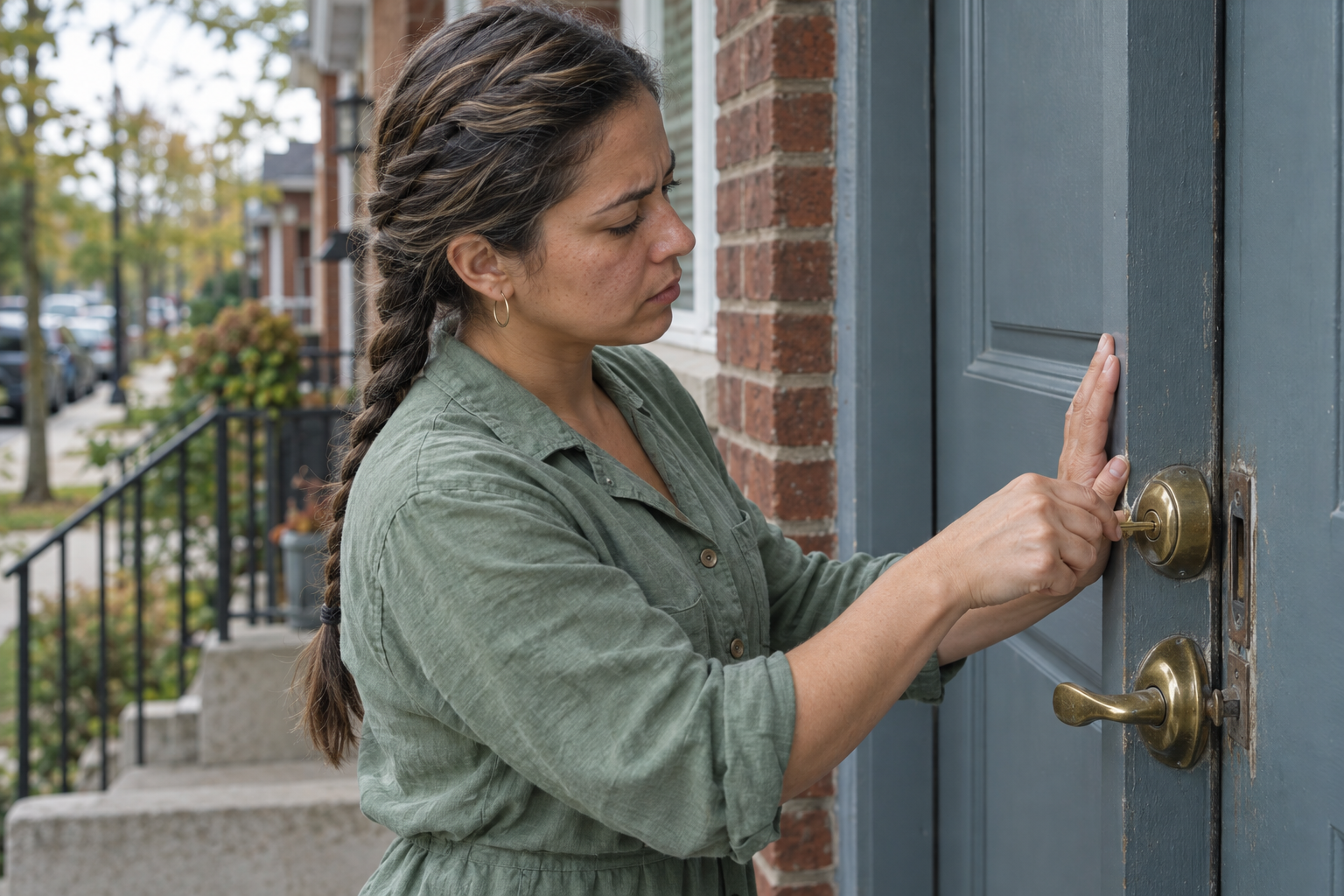
- A key that spins a full 360 degrees with no resistance usually means the cylinder’s tailpiece or cam has snapped or disengaged, and no amount of pushing on the door will fix it.
- A deadbolt that turns only partway is usually binding on the strike plate, and pushing the door toward the frame or lifting the handle while turning releases many of these.
- Forcing the door concentrates load at the strike area, the weakest part of a wood jamb, and commonly splits the frame on older doors around Etobicoke.
- Doors near Lake Ontario in Long Branch, New Toronto and Mimico swell in humid summers and shrink in winter, pulling a standard 1-inch deadbolt out of line with its strike.
- Smart locks such as Schlage Encode, Yale Assure and August still drive a mechanical bolt, so a binding strike stops the motor and the key alike.
- Renters in Ontario should call their landlord first, because the Residential Tenancies Act, 2006 bars tenants from altering the locking system without the landlord’s consent.
Here’s what surprises most people: when a key turns and the door stays shut, the lock itself is usually fine. The part that failed is a sliver of metal behind it, or a bolt pinned in place by a door that moved.
If you’re a homeowner in Long Branch, New Toronto or Mimico standing on the porch with a key that spins in your hand, what you do in the next few moments matters more than anything else. Your shoulder decides whether this ends as a quick cylinder repair or a door-frame job.
The Short Answer: Should I Force a Door Before Door Lock Repair in Lakeshore?
No, you should not force a door when the key turns but the door won’t open in Lakeshore Toronto or anywhere else in the West GTA. A key that rotates without releasing the door is telling you that the connection between the cylinder and the bolt has failed, or that the bolt is pinned under pressure, and neither problem responds to a shoulder.
Try one gentle move first: push the door toward the frame and lift the handle while you turn the key, because that frees a binding deadbolt more often than people expect. If the key spins all the way around with no resistance, the tailpiece or cam is broken, and the door needs door lock repair from an Etobicoke locksmith working at the lock, not at the jamb.
Force rarely wins. It usually just enlarges the repair.
The Full Answer: Why Does a Key Turn Without Opening the Door?
A key that turns without opening the door points to one of five failures: a broken or disengaged tailpiece, a deadbolt binding on its strike, a stuck latch, a seasonal fit problem, or a fault inside a mortise, multipoint or smart lock. Each one feels slightly different in your hand. The feel is the diagnosis.
Is your key even connected to the bolt anymore?
The tailpiece is a flat metal bar sticking out of the back of your outside cylinder, and on a standard Schlage, Kwikset or Yale deadbolt it passes through the bolt mechanism and rotates it. When that bar snaps, twists or slips out of its slot, the key turns normally and nothing behind it moves.
You can usually hear the difference. A healthy deadbolt gives firm resistance and then a solid thunk at about a quarter turn, while a broken tailpiece gives a hollow, weightless spin with no click at all.
Mortise cylinders use a cam instead of a tailpiece, a small rotating lobe screwed to the back of the cylinder. A loose cam, or a cylinder that has backed out because its set screw loosened, produces the same empty spin.
In our experience, the thin stamped tailpieces on bargain big-box deadbolts are the ones we find twisted most often. Those budget deadbolts carry a second problem worth knowing: most can be picked in under 10 seconds, and serious break-ins specifically target that class of hardware.
Pushing harder does nothing here. The key simply has nothing left to push.
Is the deadbolt binding against the strike plate?
A deadbolt that turns partway and then stiffens is usually binding: the bolt is pressed against the edge of the strike plate because the door has sagged, the house has settled, or compressed weatherstripping is pushing the door outward. Standard residential deadbolts throw a 1-inch bolt, so even a small shift in alignment puts real friction on it.
This is the one case where your hands can actually fix it. Push the door firmly toward the frame (or pull it toward you if it swings outward), lift up on the handle to counter a sagging hinge side, and turn the key again with steady pressure.
Here’s an honest admission: this release is so simple that we sometimes feel a little sheepish arriving for it. The real repair comes afterward, usually adjusting or filing the strike, tightening hinges, or swapping short hinge screws for 3-inch screws that bite into the framing stud.
Is the latch, not the deadbolt, holding the door shut?
The spring latch in your knob or lever can hold a door shut even after the deadbolt has fully retracted, which is why the key seems to work while the door still won’t budge. On a handleset with a thumb latch, the thumb piece has to be pressed all the way while you pull; on a knob or lever, the spindle has to retract the latch through its full travel.
A drooping lever or a knob that spins loosely usually means a broken spindle or a detached latch connection. Many entry latches also have a small dead latch plunger beside the main latch, and when paint, grime or a misaligned strike jams that plunger, the latch won’t retract smoothly.
Check the gap between door and frame. The thicker, squarer bolt higher up is the deadbolt; the angled tongue lower down is the latch.
Why do Lakeshore doors bind more in winter and summer?
Homes close to Lake Ontario, in Long Branch, New Toronto and Mimico, deal with damp summer air that swells wood doors and frames, then hard winter cold that shrinks them again. That yearly cycle slowly drags a deadbolt out of line with its strike, so a lock that worked smoothly in October can bind by February.
Winter adds ice. A January wind coming off the lake drives moisture into strike pockets and keyways, and a thin film of ice is enough to stop a bolt from retracting while the key still turns. Road salt tracked onto porches and storm doors also speeds corrosion on exterior latches across Etobicoke and Mississauga.
Fiberglass and steel doors move less than wood. They aren’t immune, though, because the wood frame around them still swells and shrinks.
Do mortise, multipoint and smart locks fail differently?
Mortise locks, the tall rectangular lock bodies common in older homes, apartment buildings and storefronts along The Queensway, can spin when the cylinder unthreads slightly or its cam loses position. High-security cylinders from Medeco and Mul-T-Lock sit in many of these doors, and the cylinder is rarely the weak point; the cam or the mortise body behind it usually is.
Multipoint locks on many newer fiberglass and uPVC doors latch at three points along the door edge, and most need the handle lifted fully before the key will turn the mechanism. If the key turns but the hooks stay engaged, the gearbox inside the door edge may be failing, and yanking the handle can strip it completely.
Smart locks such as the Schlage Encode, Yale Assure and August still move a mechanical bolt. The Schlage Encode and keyed Yale Assure models include a physical cylinder, and the August retrofit mounts over your existing deadbolt on the inside, so your original key and tailpiece still do the mechanical work.
A binding strike stops the motor and the key alike. A smart lock that grinds, retries on its own or drains batteries fast is often fighting the same misalignment a plain deadbolt would.
| What the key feels like | Most likely cause | Safe thing to try | Stop and call when |
|---|---|---|---|
| Spins a full 360 degrees, no click | Broken or disengaged tailpiece or cam | Use another entrance | Right away: the key has no connection to the bolt |
| Turns partway, then stiffens | Deadbolt binding on the strike plate | Push door toward frame, lift handle, turn again | It still binds after a few gentle tries |
| Deadbolt retracts, door still held | Stuck latch or jammed dead latch plunger | Turn knob or lever fully while pulling | Latch won’t retract with the handle fully turned |
| Key turns, lever droops or knob spins loose | Broken spindle or detached trim | Hold the lever level while turning | Spindle or trim is visibly broken |
| Multipoint door, hooks stay engaged | Gearbox fault or wrong handle sequence | Lift handle fully first, then turn the key | Handle goes slack or grinds |
| Winter: turns stiffly, bolt barely moves | Ice in the strike or a contracted frame | Lock de-icer or a gently warmed key | The lock refreezes repeatedly |
A free 360-degree spin means a broken tailpiece or cam and needs a locksmith. A partial turn that stiffens is usually a binding 1-inch deadbolt you can often release by taking pressure off the door. Mortise, multipoint and smart locks from brands like Medeco, Mul-T-Lock, Schlage Encode and August fail at the cam, gearbox or strike far more often than at the cylinder.
What can you safely try before you call a locksmith?
The safe checks for a key that turns without opening the door take pressure off the bolt and identify which part is holding, without prying or striking anything. Work through them in order and stop at the first sign of a free spin or grinding.
Find which bolt is holding
Look into the gap between the door edge and the frame. A square bolt up high is the deadbolt; an angled tongue lower down is the latch.
Take the load off the bolt
Push the door firmly toward the frame, or pull it toward you on an outswing door, and lift up on the handle while you turn the key.
Turn fully in both directions
A deadbolt needs roughly a quarter turn (90 degrees) to throw or retract. A half-hearted turn can leave the bolt stuck halfway out.
Work the latch at the same time
With the deadbolt retracted, hold the lever down or the thumb piece pressed and pull. On a multipoint door, lift the handle fully first.
Use dry lubricant only
A small puff of graphite or a dry PTFE lubricant in the keyway helps a gritty cylinder. Skip thick household oils, which trap dust and gum up the pins.
Stop at a free spin or grinding
A key that spins 360 degrees, or a handle that grinds, means an internal break. That’s the point to book an emergency lockout service in Etobicoke.
Skip hot water, screwdrivers jammed into the keyway and pry bars at the strike. Each one turns a parts-level fix into a door or frame repair, and the gritty black smudge graphite leaves on your fingertips is the messiest thing this process should involve.
When the Answer Is Different: Are There Times You Shouldn’t Wait or Shouldn’t Touch the Lock?
Yes, there are five situations where the usual advice for a key that turns but a door that won’t open (stop, take pressure off the bolt, call a locksmith) changes. Read the one that fits you.
Someone or something is in danger inside. If a child, a vulnerable adult, a pet in distress or something on the stove is behind that door, call 911. Toronto Fire Services can force entry, and the door frame is the least important thing in that moment.
You rent. For renters in Mimico and New Toronto apartment buildings with mortise locks, the answer changes: call your landlord or property manager first. Ontario’s Residential Tenancies Act, 2006 says a tenant shall not alter the locking system without the landlord’s consent, and a landlord who changes it must give the tenant replacement keys.
Renters also make a quieter mistake. Moving into a new place without rekeying means previous tenants’ keys still work, and the same cylinder often rotates through every turnover, so ask that any repaired or replaced cylinder be put through lock changes and rekeying at the same visit.
It’s your car door. On a vehicle, a key that turns without unlocking usually means a disconnected linkage rod or a failed lock actuator inside the door panel, not a lock problem in the household sense. Calling the dealership for a car key replacement typically costs 2-3 times more than a mobile locksmith for the exact same key, so check car key and automotive lockout help before you book a tow.
You see signs of tampering. Fresh tool marks around the keyway, a cylinder face twisted in the door, or brass shavings on the threshold suggest a forced-rotation attempt. Don’t keep working the lock; photograph it and report it to the Toronto Police Service (or Peel Regional Police in Mississauga) before the hardware is replaced.
It’s a padlock on a gate. A Master Lock padlock whose key turns but whose shackle won’t release is usually rusted or iced, and working it harder with a penetrating lubricant carries little risk. The padlock doesn’t hold a door frame together. Swap it out.
Our Take After Years of Locksmithing in Etobicoke: What Actually Matters When a Key Spins?
After years of locksmith work across Etobicoke and the West GTA, our honest opinion is that people overweigh the lock brand and underweigh the door. A premium Schlage or Medeco deadbolt in a sagging door will bind just like a budget one, and a well-aligned strike makes ordinary hardware feel smooth.
The thing we’d tell a friend in Lakeshore is simple: the moment your key turns but the door won’t open and the cylinder spins with no resistance, stop touching the door. Call, describe exactly how the key feels in your hand, and let the repair stay at the lock. That description alone tells us most of what we need to bring.
One more opinion. Be wary of anyone who gives a single flat number over the phone for a spinning cylinder before asking what lock you have, because real cost depends on lock type and an on-site assessment, and reputable locksmiths quote a range rather than a fixed teaser figure. Ask us directly and we’ll walk you through what the visit involves before any work starts.
Frequently Asked Questions About Keys That Turn but Doors That Won’t Open
Can a locksmith open a door without damage when the key turns but nothing happens?
A locksmith can usually open a door with a spinning cylinder without damaging the frame, because the work happens at the lock rather than the jamb. Depending on the hardware, that means manipulating the bolt through the cylinder opening, removing the exterior cylinder, or working the latch directly, and most residential Schlage, Kwikset and Yale deadbolts can be opened and repaired in a single visit.
Is a lock cylinder that spins freely a sign of a break-in attempt?
A lock cylinder that spins freely is usually caused by wear or a snapped tailpiece, but it can also follow a forced-rotation attempt with a wrench or puller. Fresh tool marks, a cylinder face twisted in the door, or brass shavings below the keyway point to tampering, and in Toronto that is worth reporting to the Toronto Police Service non-emergency line before the hardware is replaced.
Should I repair or replace a deadbolt after the tailpiece breaks?
A deadbolt with a broken tailpiece can often be repaired with a new cylinder or tailpiece if the bolt and housing are sound, but bargain big-box deadbolts are usually better replaced with a sturdier ANSI/BHMA Grade 1 or Grade 2 model from a brand such as Schlage, Yale, Mul-T-Lock or Medeco. If you rent or recently moved in, have the new cylinder rekeyed at the same visit so no previous key still works.
Can cold weather make a key turn without unlocking the door?
Cold weather in Etobicoke and the West GTA can make a key turn while the bolt barely moves, because ice forms in the latch or strike pocket and door frames shrink slightly in January and February. A lock de-icer or a gently warmed key usually frees it, while pouring hot water into the lock is a mistake because the water refreezes deeper inside the cylinder.
Sources
- Ontario rules on tenants and landlords altering locking systems (sections 24 and 35): Residential Tenancies Act, 2006, Ontario e-Laws
- Residential lock performance grading (ANSI/BHMA Grades 1, 2 and 3): Builders Hardware Manufacturers Association
- Schlage deadbolts and the keyed Schlage Encode smart deadbolt: Schlage
- Kwikset deadbolts and SmartKey rekeyable cylinders: Kwikset
Etobicoke Locksmith
Have a similar question about a key that spins, a deadbolt that binds or a latch that won’t let go? Tell our uniformed mobile technicians how the key feels in your hand, and we’ll explain what the visit involves before any work begins.
 Listen to article
- A Customer Asked: “How Long Does It Actually Take a Locksmith to Break Into a House?” — The Real Numbers
- A Long Branch Customer Asked: “Can You Replace a Mailbox Lock Without the Key?”, Here’s the Process
- A Customer Asked: “Can You Rekey My Lock Without the Original Key?” — A Locksmith’s Honest Answer
- A Homeowner in New Toronto Asked: “Why Won’t My Deadbolt Turn All the Way?” — What We Found
- A Customer Asked: “Can You Make a Duplicate Key for a Mul-T-Lock Without the Original Card?” — What’s Possible