
Last updated: September 29, 2026
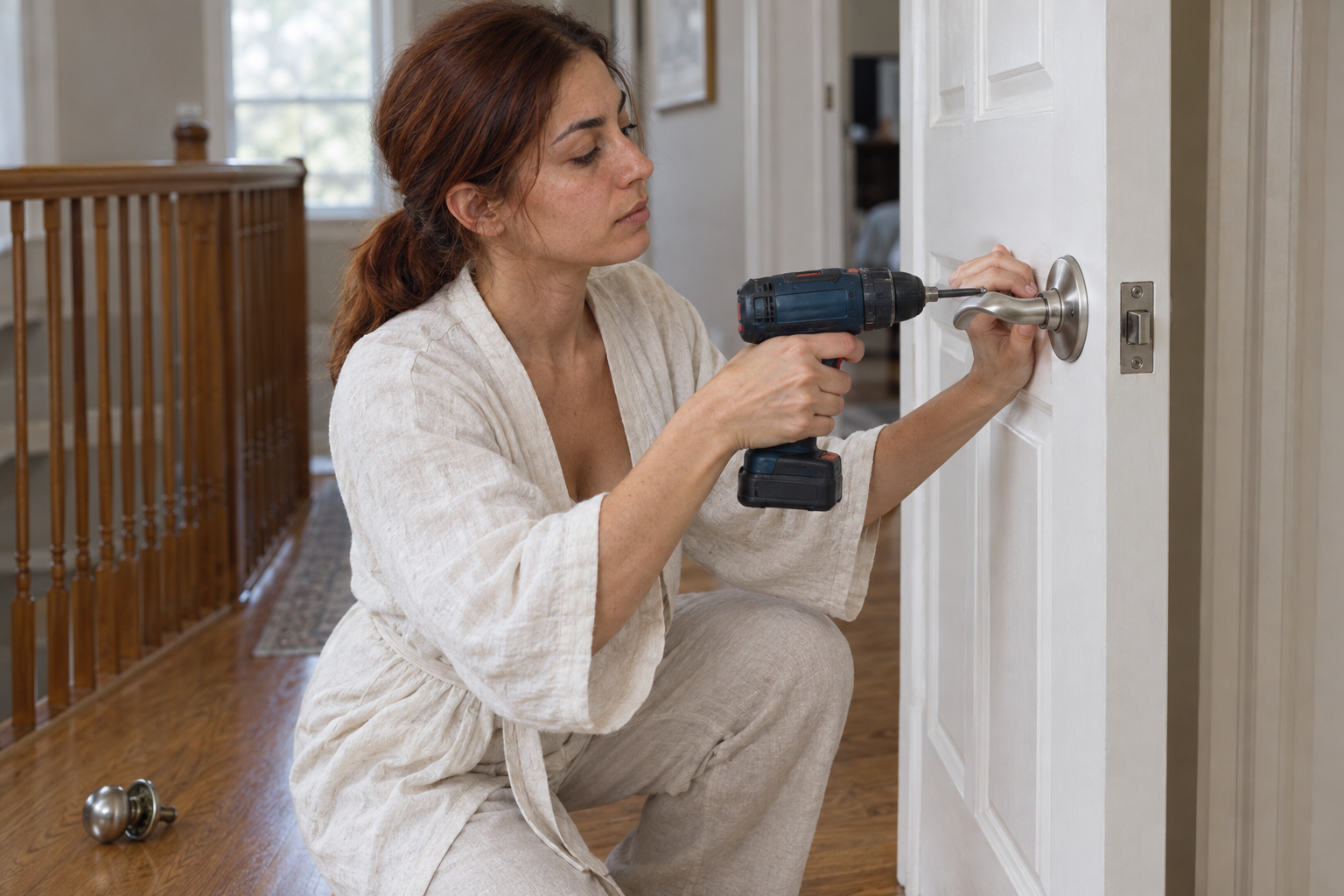
In a lever handle vs knob lock accessibility upgrade Mississauga home owners are planning, lever handles win. They open with a downward push from a palm, wrist, elbow or closed fist instead of the tight grip and wrist twist a round knob demands. Most doors are bored for a 2-1/8 inch (54 mm) lock with a 2-3/8 inch (60 mm) backset, so Schlage and Kwikset levers usually drop into the existing holes and the switch can happen door by door without new carpentry.
Most families assume the round knob is the only barrier. In the homes we walk through, the stiff little deadbolt thumbturn above it is often worse. What sets Mississauga apart from our Etobicoke and Lakeshore calls is the door mix. You’ll find builder-grade knob sets in suburban backsplits and two-storeys, older painted doors in village cores like Port Credit and Streetsville, and fire-rated condo entry doors near Square One. Each one needs a different plan.
This guide is for you if you’re the adult child planning a parent’s return home after a hip replacement or a stroke, and the occupational therapist’s discharge notes mention door hardware. It is not for someone shopping for a decorative refresh. It covers what to swap, what to leave alone, and the security step most families forget.
- Lever handles operate without tight grasping or wrist twisting. The Ontario Building Code’s barrier-free design section (Section 3.8) applies that same principle to accessible doors in public and multi-unit buildings.
- Standard door prep in North America is a 2-1/8 inch (54 mm) cross bore with a 2-3/8 or 2-3/4 inch backset, so most knob-to-lever swaps on post-1970 Mississauga doors need no drilling.
- ANSI/BHMA grading runs from Grade 1 (heaviest duty) to Grade 3. For a front door where someone leans on the handle for balance, we steer toward Grade 2 or better.
- The federal Home Accessibility Tax Credit is a 15% non-refundable credit for eligible renovations in the home of someone 65 or older, or someone eligible for the disability tax credit.
- Keypad smart locks such as the Schlage Encode and Yale Assure Lock 2 remove the key-gripping step at the front door, a problem a lever alone does not solve.
- Rekeying after caregivers, contractors or previous tenants have held keys is the step families skip most often when setting up an aging-in-place home.
- Mississauga neighborhood facts
- Why is Mississauga different for this upgrade?
- Is a lever really easier than a knob?
- What common problems do we see in Mississauga homes?
- How do we approach accessibility door upgrades in Mississauga?
- Our take after years of fitting door hardware
- Frequently asked questions
- Sources
- Mississauga became a city in 1974. Much of its detached and semi-detached housing went up during the suburban build-out from the 1960s through the 1990s.
- The 2021 Census counted 717,961 residents, making Mississauga Ontario’s third-largest city after Toronto and Ottawa.
- Etobicoke Creek forms much of the boundary with Toronto. The southern edge runs along Lake Ontario through Lakeview, Port Credit and Clarkson, where humid summers and freeze-thaw winters make wooden doors swell and shrink.
- Older village cores such as Port Credit and Streetsville still hold pre-war and mid-century houses whose doors can carry non-standard bores or old mortise hardware.
- The City Centre around Square One has a dense cluster of high-rise condos, where unit entry doors are fire-rated assemblies governed by condo corporation rules.
Why Is Mississauga Different for a Lever Handle vs Knob Lock Accessibility Upgrade?
Mississauga’s housing stock splits into three door types, and each one changes what a lever handle vs knob lock accessibility upgrade looks like on the ground. The three are suburban builder-grade doors, older village-core doors, and fire-rated condo doors. A single approach for all three is how jobs go sideways.
Suburban builder-grade doors
Houses from the 1970s through the 1990s typically have 1-3/8 inch hollow-core interior doors and 1-3/4 inch exterior doors, both bored to the modern standard. These are the easy ones. A passage or privacy lever from Schlage or Kwikset fits the existing holes.
The one catch is that hollow-core faces crush if the lever’s through-bolts are over-tightened. When that happens, the rose wobbles within a month. We snug them by hand for that reason.
Older doors in Port Credit and Streetsville
Older solid-wood doors in the village cores can have smaller cross bores, latches buried under decades of paint, or mortise locks set into the edge of the door. A modern tubular lever will not seat in those without enlarging the bore or switching to a mortise-style lever.
That enlargement has a health angle that renovation content rarely mentions. Health Canada advises that homes built before 1960 are likely to contain lead-based paint. We treat old door paint as suspect and capture the dust rather than letting it drift across a hallway where a frail parent will be walking.
Condo entry doors near the City Centre
Condo unit entry doors in high-rise buildings are fire-rated assemblies that must stay self-closing and self-latching. Drilling new holes or fitting hardware the door wasn’t prepped for can compromise the rating. Many condo corporations also control what hardware appears on the corridor side, so management usually has to sign off first.
Then there’s the lake. Doors near Lake Ontario swell in a muggy August and shrink back by January. You can hear the problem before you see it: a dry scrape as the latch drags across the strike plate before it drops. When the latch binds, the person has to shove the door and press the lever at the same time. That matters more than the handle.
Is a Lever Handle Really Easier Than a Knob Lock?
A lever handle is easier than a knob lock for almost anyone with reduced grip strength, because it turns a grip-and-twist motion into a simple push. Someone with rheumatoid arthritis in the hands, a Parkinson’s tremor, or one hand weakened by a stroke finds the knob demands exactly the motion that hurts most. Levers also work when both hands are busy with a walker, a cane or a bag of groceries.
Knobs still win in a few honest cases. We lay those out in the table rather than pretending levers are perfect everywhere.
| Factor | Lever handle | Round knob | Better choice |
|---|---|---|---|
| Grip strength needed | Push with palm, fist or elbow | Tight grasp plus wrist twist | Lever |
| Hands full (walker, cane, laundry) | Operable with forearm | Needs a free hand | Lever |
| Fits standard 2-1/8 inch bore | Yes, on most modern doors | Yes | Tie |
| Dogs and toddlers opening doors | A jumping dog can push it down | Hard for paws and small hands | Knob |
| Dementia with exit-seeking | Makes exterior exits easier | Slight natural deterrent | Ask an OT first |
| Snagging sleeves and bag straps | Straight levers can catch; return levers don’t | Rarely snags | Return-style lever |
| Smart hardware options | Yale Assure Lever, Schlage Encode Lever | Very limited | Lever |
The dementia row is the one national renovation guides skip. Easier exits are not always safer exits. If a parent has started wandering, the front door may need a keypad deadbolt or a door alarm alongside the lever, and that call belongs to the occupational therapist and the family, not the hardware store.
If you don’t have an OT yet, the Ontario Society of Occupational Therapists runs a public directory for finding one privately. Hospital discharge teams and Ontario Health atHome can also arrange assessments.
What Common Problems Do We See in Mississauga Homes?
The most common problems we see in Mississauga accessibility door upgrades have little to do with the lever itself. They come from the hardware around it: the deadbolt, the strike, the keys and the quote. Four patterns repeat.
1. New lever, same unusable deadbolt
Families swap the front-door knob for a lever and leave a stiff, tiny deadbolt thumbturn above it. Honestly, we underestimated this problem for years. The thumbturn is often harder on arthritic fingers than the knob ever was.
The fix often gets done badly too. Bargain big-box deadbolts are a false economy on an aging parent’s front door. Most can be picked in under 10 seconds, and serious break-ins specifically target that class of lock. A senior living alone is exactly the household that shouldn’t carry the weakest cylinder on the street.
2. Levers that sag, bind or fight the door
Bargain levers use light return springs. After months of someone leaning on them for balance, the lever droops and stops springing back to level. A drooping lever looks broken and often feels broken.
Seasonal swelling near the lake makes it worse. If the strike plate sits a few millimeters off after a humid summer, the latch won’t release cleanly. The user ends up pressing the lever with one hand and body-checking the door with the other.
3. Keys scattered across caregivers, contractors and past tenants
Aging in place usually means more people holding keys: personal support workers, a cleaner, neighbors, siblings who visit on rotation, and the contractor who installed the grab bars. Almost nobody rekeys when that list changes.
The same gap shows up when a parent downsizes into a rental or a basement apartment. If the unit isn’t rekeyed, the previous tenants’ keys still work, and the same cylinder rotates through every turnover. Similar false savings appear with a parent’s car: calling the dealership for a replacement key typically costs 2-3 times more than a mobile locksmith charges for the exact same key.
4. Slip-on converters and flat phone quotes
Rubber knob-to-lever converters sold by home health retailers are a reasonable stopgap for a week after discharge. They are not a fix. They twist loose on the knob, and a converter that spins without opening the door is worse than no converter at all.
The other trap is relying on a flat phone quote. A real accessibility door job depends on bore size, door condition, strike alignment and the lock type on each door, and nobody can see that over the phone. Reputable locksmiths quote a range and confirm after an on-site look.
How Do We Approach Accessibility Door Upgrades in Mississauga?
We approach Mississauga accessibility door upgrades by starting with the person, not the product catalog. Our uniformed technicians walk each door with whoever will use it daily, ideally with the OT’s notes in hand. The sequence below is how a typical visit runs.
Watch the user try each door
We ask them to open it with their weaker hand, then while holding a cane or walker. The doors that cause trouble reveal themselves in about a minute.
Measure backset, bore and door thickness
A 2-3/8 or 2-3/4 inch backset and a 2-1/8 inch bore mean a clean swap. Anything else gets flagged before a single part is ordered.
Fix the strike before the handle
We realign or re-cut strike plates so the latch releases with light lever pressure in both summer and winter conditions.
Match grade and brand to the door
Interior doors get residential passage or privacy levers. Exterior and balance-support doors get Grade 2 or better hardware with a firm return spring.
Solve the deadbolt and the keys
We fit a keypad deadbolt or a large-thumbturn deadbolt, then rekey so only current caregivers and family hold working keys.
Retest with the user
The same person repeats step 1 on every changed door before we pack up. If they hesitate, we adjust.
Which brands suit which Mississauga doors?
For interior doors in suburban houses, Schlage and Kwikset residential levers are our default. Both fit the standard bore, and most current models are reversible for left- or right-hand doors. Kwikset’s SmartKey cylinders are handy on exterior levers because they can be rekeyed quickly when a caregiver changes.
At the front door, the Schlage Encode and Yale Assure Lock 2 give a parent a keypad instead of a key, and each caregiver can get a personal code you delete later. The Yale Assure Lever suits the garage-to-house door that many suburban homes have, where hands are full coming in from the car.
In condos where the corridor side can’t change, the August Wi-Fi Smart Lock is useful because it replaces only the interior thumbturn and keeps the existing exterior hardware. For families who want tight control over who can copy keys, Mul-T-Lock and Medeco restricted keyways stop duplicates being cut at a mall kiosk without authorization. Yale, August, Medeco and Mul-T-Lock all sit under the ASSA Abloy group.
You can read more about our residential lock and door hardware service and our smart lock installation options for aging-in-place homes.
Measure the backset and bore, fix the strike, then choose the lever. Schlage and Kwikset levers cover most interior doors. A Schlage Encode or Yale Assure keypad deadbolt solves the front-door key problem that a lever leaves untouched.
Our Take After Years of Fitting Door Hardware
Our view after years of fitting door hardware across Etobicoke, Lakeshore and Mississauga is that families overweight the finish. Satin nickel versus matte black eats the conversation, while the stuff that actually decides whether a parent can get through a door goes unasked. Latch alignment, spring feel and the deadbolt matter far more.
What surprised us early on was how often the bathroom door was the real emergency. A privacy lever needs an emergency release on the outside so a family member can open it with a small tool if someone falls inside. Check that feature on every bathroom lever you buy. It’s a small detail with serious consequences.
The one thing we’d tell a friend is simple: stand at the door with the person who will use it and watch. Five minutes of watching beats an hour of browsing hardware aisles. Then rekey, because an accessible door that half the neighborhood can open isn’t finished. Our lock rekeying after a move or caregiver change is often the shortest part of the visit.
Frequently Asked Questions from Mississauga Homeowners
Can I replace the knobs on my Mississauga condo’s entry door with levers myself?
Mississauga condo entry doors are usually fire-rated assemblies that must stay self-closing and self-latching, so hardware changes often need approval from your condo corporation or property manager first. Interior unit doors such as bedrooms, bathrooms and closets are normally yours to change, and a standard Schlage or Kwikset passage lever fits the usual 2-1/8 inch bore. For the entry door, ask management for the approved hardware list before buying anything.
Do lever handles qualify for the Home Accessibility Tax Credit for a senior in Mississauga?
Lever handles installed for a Mississauga senior may count toward the federal Home Accessibility Tax Credit, a 15% non-refundable credit for eligible renovations in the home of someone 65 or older or someone eligible for the disability tax credit. The CRA looks at whether the work helps the person gain access to, move around in, or function within the home, or reduces the risk of harm there. Keep itemized invoices and confirm eligibility on the CRA line 31285 page or with your accountant before filing.
Will new levers fit the doors in an older Port Credit or Streetsville house?
Older Port Credit and Streetsville houses sometimes have pre-1970 doors with smaller bores, painted-over latches or old mortise locks, so a modern lever may need the bore enlarged or a mortise-style lever set. Doors bored to the modern 2-1/8 inch standard with a 2-3/8 or 2-3/4 inch backset usually take a lever with no drilling at all. A quick on-site measurement of each door tells you which group it falls into.
Should my parent’s Mississauga front door get a lever or a keypad smart lock?
A Mississauga front door used by a parent living alone usually benefits from both: a Grade 2 or better lever for the latch and a keypad deadbolt such as the Schlage Encode or Yale Assure Lock 2, so there is no key to grip and turn. The keypad also lets you give a personal support worker or family member their own code and delete it when that person stops visiting. If your parent has dementia and a history of wandering, talk to their occupational therapist before making the exterior door easier to open.
Sources
- Home Accessibility Tax Credit eligibility, 15% rate and qualifying-individual rules: Canada Revenue Agency, Line 31285 Home Accessibility Expenses
- Barrier-free design requirements (Section 3.8) in the Ontario Building Code: Ontario e-Laws, O. Reg. 332/12 Building Code
- Mississauga 2021 population figure: Statistics Canada, 2021 Census Profile
- ANSI/BHMA Grade 1 to Grade 3 hardware grading: Builders Hardware Manufacturers Association
Planning several doors at once? Our mobile locksmith team serving Etobicoke, Lakeshore and Mississauga can assess every door in one visit and quote a range for the work after seeing the hardware.
Etobicoke Locksmith
Book a Mississauga Lever Handle Accessibility Walk-Through →
 Listen to article
- August Wi-Fi Smart Lock vs Schlage Encode Plus: Which One Actually Works in a Mississauga Townhouse
- Schlage Encode vs Yale Assure vs August Wi-Fi: Which Smart Lock Handles Etobicoke’s Freeze-Thaw Cycles
- August Wi-Fi Smart Lock vs Yale Assure vs Schlage Encode: Which Integrates Best With a Mississauga Smart Home
- Schlage Encode vs Yale Assure vs August Wi-Fi: Which Smart Lock Handles Etobicoke’s Freeze-Thaw Cycles
- Schlage Encode vs Yale Assure: Which Keypad Lock Handles Etobicoke’s Freeze-Thaw Cycles Without Failing