
Last updated: October 4, 2026
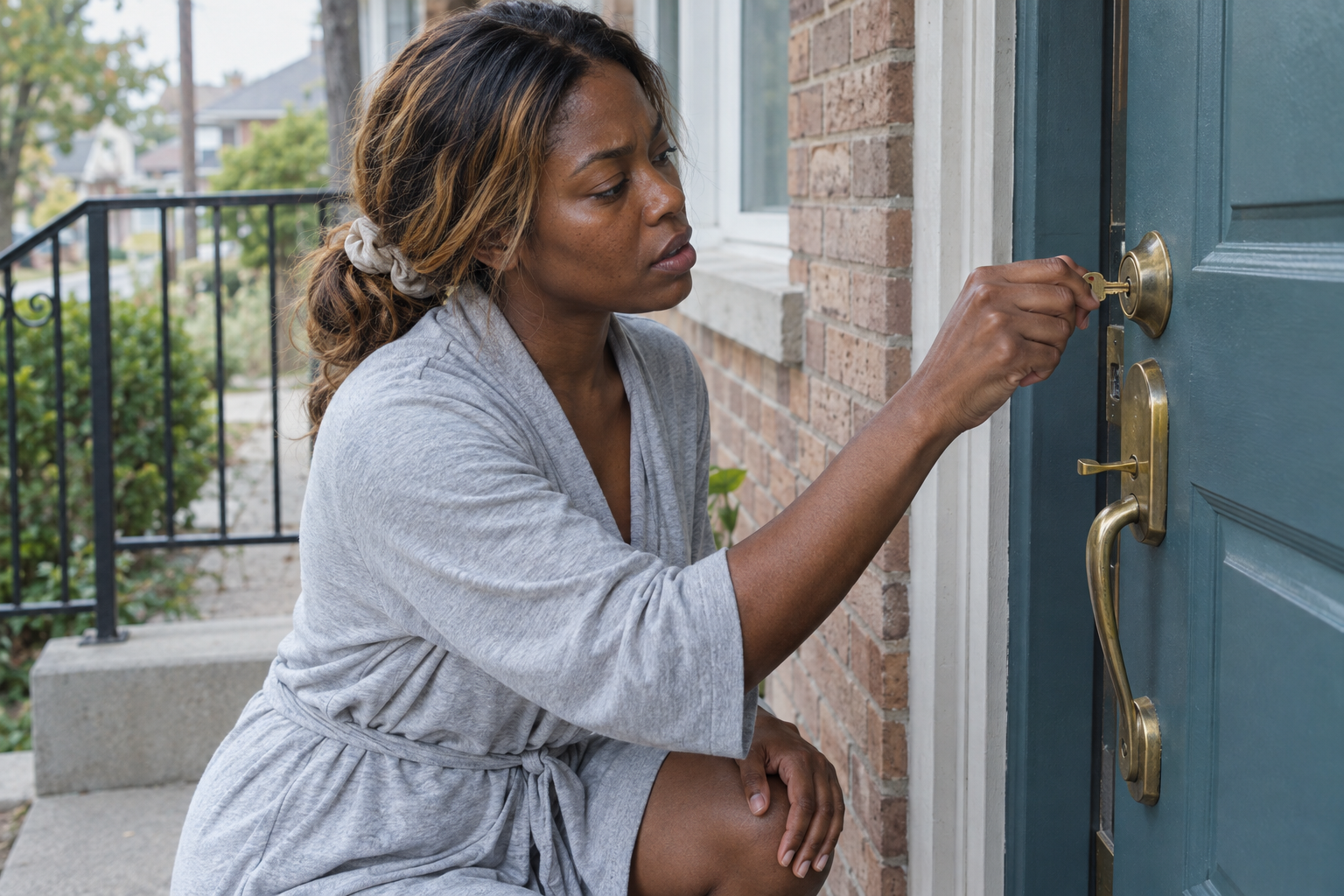
When we make a new house key from the lock without the original in Etobicoke, your lost key still works, because reading a cylinder’s pin depths and cutting a matching key changes nothing inside the lock. To shut the lost key out, the cylinder has to be rekeyed (re-pinned to a new combination) or replaced, and on a standard Kwikset or Schlage deadbolt that happens on site during the same visit. A new key gets you back inside. Only a rekey locks the old key out.
The call usually comes at an awkward hour. The keys went missing somewhere between the GO train and the front porch, and someone is turning a jacket pocket inside out on a cold step in Mimico. If you’re a tenant in a New Toronto or Long Branch rental who just lost the only key the landlord handed over, or a Lakeshore homeowner who can’t say whether the ring fell in a parking lot or disappeared from a gym bench, this walk-through is for you.
What surprised me early in this trade is how many people assume a new key means a new lock. It doesn’t. Understanding the difference before the technician arrives is what decides whether you end the night actually secure or just back inside.
- Cutting a new key from the lock does not disable a lost key. Both keys open the cylinder because the pins inside are unchanged.
- Rekeying swaps the small key pins inside the cylinder so the lost key no longer lifts them to the shear line, and it is done on site without replacing the deadbolt.
- Kwikset residential cylinders use 5 pins with 7 possible depths, while Schlage uses 5 or 6 pins with 10 possible depths, which is why a locksmith can read either lock and cut a key by code.
- Medeco and Mul-T-Lock high-security keys are controlled through authorized dealers and registered key cards, so losing one usually means re-coring rather than a quick code cut.
- Renters in Mimico, New Toronto and across the West GTA should know that previous tenants’ keys still work in any cylinder that wasn’t rekeyed at turnover.
- Keyed smart locks and August retrofits still have a physical key path, so a lost key calls for a rekey plus a review of app users and codes.
- Why a key cut from your lock is a duplicate of the lost one, mechanically speaking
- The 7 steps a technician follows to decode a Kwikset or Schlage cylinder and cut a working key with no original
- The exact tools on the bench, from the Original Lishi 2-in-1 decoder to the Kwikset SmartKey learn tool
- Where decoding goes wrong: weathered cylinders near the lake, master-keyed buildings and high-security Medeco or Mul-T-Lock locks
- The questions to ask on the phone so you get a rekey, not just a copy
Does Your Lost Key Still Work When You Make a New House Key From the Lock Without the Original in Etobicoke?
Yes, a lost key keeps working after a locksmith cuts a new key from the lock, because the new key carries the same combination the lost one does. Nothing inside the cylinder moves to a new setting just because a second key now exists.
Inside a standard Kwikset or Schlage deadbolt sits a row of spring-loaded pin stacks. Each stack has a key pin of a specific length with a driver pin above it, and the plug turns only when every split between them lines up at the shear line.
Your key’s cuts are simply a physical record of those pin lengths. When we read the pins and cut a matching key, we reproduce that record. The lost key holds the identical record, so it lifts every pin to exactly the same height.
Two keys. One combination.
That is the part most people miss. A fresh key solves the problem of getting inside; it does nothing about who else can get inside. Here is how the three realistic options compare.
| Option | What changes in the lock | Does the lost key still work? | When it makes sense |
|---|---|---|---|
| New key cut from the lock | Nothing. The pins stay as they were. | Yes | The key was lost somewhere it can’t be tied to your address, like your own backyard snowbank. |
| Rekey the cylinder | Key pins swapped for new lengths; new keys cut to the new combination. | No | The lost key was attached to ID, a car fob, a gym tag or anything with your name or address. |
| Replace the cylinder or lock | New hardware with its own combination. | No | The lock is a budget big-box model, badly worn, or a high-security cylinder whose key card is also lost. |
A key cut from your lock is a duplicate of the lost key, so both open the door. Rekeying changes the pin lengths inside the cylinder and is the only way to make the lost key useless without replacing hardware. Replacement makes sense when the lock itself is weak, worn or key-controlled.
The Process, Step by Step: How Does a Locksmith Make a Key From the Lock With No Original?
A locksmith makes a key from the lock with no original by identifying the keyway, reading the depth of each pin, and cutting a blank to those depths on a code machine, then deciding with you whether to rekey. Here is what actually happens when we make a new house key from the lock without the original in Etobicoke, Mississauga or along the Lakeshore, in the order we do it.
- Confirm you belong at this address. Before any tool touches the lock, we ask for photo ID that matches the address, or a lease, property tax bill or utility bill in your name. For rentals, Ontario’s Residential Tenancies Act, 2006 requires tenants to get the landlord’s consent before altering the locking system, and landlords who change it must give tenants replacement keys, so we keep the landlord in the loop on any rekey.
- Identify the brand and keyway. The face of the cylinder usually names the maker: Kwikset, Schlage, Yale or Weiser on most West GTA houses, with the keyway profile (Kwikset KW1, Schlage SC1) readable in the shape of the slot. A Medeco or Mul-T-Lock face changes the plan immediately, because those are key-controlled high-security cylinders.
- Pick the least destructive way to read the lock. Our first choice is decoding through the keyway with an Original Lishi 2-in-1 tool, which picks the lock and reads each pin’s height in the same pass. If you’re already inside through a side or garage door, pulling the cylinder and reading the plug directly is faster and more accurate.
- Translate the pins into a bitting code. A Kwikset KW1 cylinder gives us five numbers, each a depth from 1 to 7, and a Schlage SC1 gives five or six numbers from 0 to 9. We check the code against the maker’s spacing and adjacent-cut rules before cutting, because a code that breaks those rules means one reading was off.
- Cut the key by code, not by eye. The blank goes into a code-cutting machine such as an HPC Blitz or a Silca code cutter, set to factory depths instead of traced from a worn key. You hear a short high whine and smell warm brass, then we deburr the edges so the key doesn’t drag across the pins.
- Test every door on that key. Many homes have the front deadbolt, a side or back door and sometimes an attached garage entry keyed alike. We test the new key in each one, both directions, with the door shut against its weatherstripping, because a key that turns with the door open can bind once the latch is under load.
- Make the copy-or-rekey call with you. This is the step that answers the question in the title. If the lost key could lead someone to your door, we re-pin the cylinder to a new combination on the spot with a Schlage or Kwikset pinning kit, cut fresh keys, and the lost key stops working.
Step 7 is where the visit pays for itself. The cylinder is often already out of the door from step 3, so re-pinning it is a natural extension of the job rather than a second appointment. If you’d like to read more about how that part works, our lock rekeying and lock change service page covers the hardware side.
Tools We Use: What Equipment Does It Take to Cut a Key From a Lock?
Cutting a key from a lock takes five core tools: a decoder pick, a plug follower, a pinning kit, a code-cutting machine and, for Kwikset SmartKey cylinders, the Kwikset learn tool. Every one of them rides in the van on a residential call.
| Tool | Example | What it does on the job |
|---|---|---|
| Decoder pick | Original Lishi 2-in-1 (KW1 and SC1 profiles) | Picks the lock and reads each pin’s height through the keyway, with no disassembly. |
| Plug follower | Sized to Kwikset and Schlage plugs | Pushes the plug out while holding the driver pins and springs in place, so nothing launches across the kitchen. |
| Pinning kit | Schlage and Kwikset rekey kits | Key pins in every factory depth, used to re-pin a cylinder to a new combination. |
| Code-cutting machine | HPC Blitz or Silca code cutter | Cuts blanks to manufacturer depths from a numeric code rather than tracing a worn key. |
| SmartKey learn tool | Kwikset SmartKey Security | Resets a SmartKey cylinder to a new key in place, as long as one working key is available. |
The tool matters less than the hands. A Lishi decoder in an untrained grip reads a slightly different depth every time, and a code machine faithfully cuts whatever wrong number you feed it.
Where It Gets Tricky: What Goes Wrong When a Locksmith Decodes a Lock?
Decoding a lock goes wrong most often in three situations: worn or corroded cylinders, master-keyed buildings, and high-security cylinders designed to defeat this exact process. Each one changes how long the job takes and whether a rekey or a new cylinder is the smarter call.
Weathered cylinders near the lake
Homes in Long Branch and along the Lakeshore take the wind straight off Lake Ontario, and front-door cylinders there collect grit, road salt and moisture over a few winters. On a January morning the plug feels sandy under the tension wrench, and worn key pins read a hair short.
That hair is how a rushed technician ends up cutting a key that works once and sticks the following week. We read twice. If the two readings disagree, the cylinder comes out and gets read on the bench, because a decoded number is only as good as the pins it came from.
Master-keyed buildings in Mimico and along The Queensway
Townhouse complexes and small rental buildings in Mimico and along The Queensway are often master keyed, which means some pin stacks carry an extra master wafer. Decode one of those carelessly and you might cut the master instead of the unit key, or rekey a unit in a way that locks the property manager’s master out.
For the property manager juggling turnovers across three buildings, that is a nightmare discovered at the worst moment, usually during a leak. We confirm the master chart before touching any cylinder in a keyed system.
High-security, SmartKey and budget locks
Medeco and Mul-T-Lock cylinders add sidebars, angled or telescoping pins and patented keyways, and their keys are issued against a registered key card through authorized dealers. When the card is gone along with the key, re-coring or replacing the cylinder is usually cleaner than trying to decode it. Kwikset SmartKey cylinders use a sidebar and wafers instead of classic pin stacks, so rekeying one without a working key often means a replacement cylinder.
At the other end, budget big-box deadbolts are easy to decode for the same reason they’re easy to attack. Rekeying one is like changing the password on a phone with no lock screen. It helps, but it isn’t the real fix.
What This Means for You as the Customer: What Should You Ask Before Booking?
The single most useful thing a customer can ask is whether the locksmith is cutting a copy of the existing combination or rekeying the cylinder, because only a rekey makes the lost key useless. When you call to make a new house key from the lock without the original in Etobicoke or anywhere in the West GTA, say up front where you think the key went and what was attached to it.
If you’re a landlord or property manager handling move-outs in Mimico or New Toronto, the same logic applies at every turnover. Renting out a unit without rekeying means previous tenants’ keys still work, and the same cylinder keeps rotating through tenant after tenant. Tenants moving in should ask the landlord directly whether it was done.
Will you cut a copy, or rekey the cylinder?
The answer tells you whether the lost key still opens your door when the technician leaves.
What proof of residence do you need?
A locksmith who cuts a key from your lock without checking ID would do the same for anyone standing on your porch.
Can you give me a range now and a firm figure on site?
Relying on a flat phone quote is a common mistake; the real job depends on lock type and an on-site look, so reputable locksmiths quote a range first.
Is my lock worth rekeying, or should it be replaced?
A budget big-box deadbolt may be better swapped for a Grade 1 Schlage B60N or a Mul-T-Lock cylinder while the door is already open.
Was anything else on that key ring?
Car keys, mailbox keys and smart-lock fobs each need their own fix, and it’s easier to plan them in one visit.
Lost house keys rarely travel alone. A lost transponder car key can still start the vehicle until it’s erased from the car’s immobilizer, and calling the dealership first typically costs considerably more than a mobile locksmith charges for the exact same key. Our mobile car key replacement and programming handles the cutting and the immobilizer side in one trip.
Smart locks add a digital layer, not a replacement for the physical one. A Schlage Encode or keyed Yale Assure still has a key cylinder, and an August retrofit sits on top of your existing deadbolt, so the old key works exactly as before. If you’re planning that upgrade anyway, see our smart lock installation and setup page. And if you’re reading this from the wrong side of the door right now, start with emergency lockout help.
Should You Rekey After Losing a House Key in the West GTA?
If the lost key could be linked to your address, rekeying is the safer choice: a new key alone will not disable the lost one. The new key is the easy part. Any competent technician can decode a Kwikset or Schlage cylinder and cut a clean key.
What actually matters is what was attached to the lost key. A ring with a car fob, a gym tag, a name on a lanyard, or a wallet holding your driver’s license is a key with a return address, and that’s a rekey-today situation. A single key that slipped out of your pocket in your own fenced yard is a different story, and we’d rather talk you out of a rekey you don’t need than sell you one.
The one thing we’d tell a friend: when you make a new house key from the lock without the original in Etobicoke or anywhere else, treat the visit as a decision point, not an errand. Ask for the rekey while the cylinder is already out of the door. It’s the cheapest moment, in effort and in hassle, that you’ll ever get.
Frequently Asked Questions
Do you need the original key to make a new house key from the lock?
Making a new house key without the original is routine for standard residential cylinders such as Kwikset KW1 and Schlage SC1, because the locksmith reads the pin depths directly from the lock and cuts by code. Expect to show photo ID or a lease, tax bill or utility bill that ties you to the address before any key is cut.
Does rekeying a lock mean replacing the whole deadbolt?
Rekeying a lock does not mean replacing the deadbolt; the technician removes the cylinder plug, swaps the key pins for new lengths and cuts keys to the new combination, all in the same on-site visit. A Kwikset SmartKey cylinder can even be rekeyed in place with the Kwikset learn tool, as long as one working key is available.
Can a locksmith make a key for a Medeco or Mul-T-Lock lock without the original?
Medeco and Mul-T-Lock keys are normally reordered through an authorized dealer against the owner’s registered key card, because both brands build their high-security cylinders around key control. If the card is lost along with the key, re-coring or replacing the cylinder is usually the cleaner path than trying to decode it.
If I have a smart lock like Schlage Encode, does a lost physical key still matter?
A lost key for a Schlage Encode, Yale Assure or August setup still matters, because the backup key cylinder (or the original deadbolt under an August retrofit) opens the door without the app. Rekey that cylinder and, in the same visit, review the app’s user list and delete any access codes you no longer recognize.
Sources
- Ontario rules on tenants and landlords altering locking systems and providing replacement keys: Residential Tenancies Act, 2006 (Government of Ontario)
- Kwikset residential locks and SmartKey Security rekeying: Kwikset (manufacturer)
- Schlage residential deadbolts, including the B60N and Schlage Encode: Schlage (manufacturer)
- Medeco high-security cylinders and key control: Medeco (manufacturer)
Etobicoke Locksmith
 Listen to article
- A Customer Asked: “Can You Rekey My Lock Without the Original Key?” — A Locksmith’s Honest Answer
- A Customer Asked: “Can You Make a Duplicate Key for a Mul-T-Lock Without the Original Card?” — What’s Possible
- A Long Branch Customer Asked: “Can You Replace a Mailbox Lock Without the Key?”, Here’s the Process
- A Customer Asked: “Can an Etobicoke Locksmith Rekey My Lock Without Replacing the Whole Thing?” — The Full Answer
- A Customer Asked: “Can You Rekey My Mississauga Condo Lock Without Replacing the Whole Hardware?” — Here’s What We Did