
Last updated: October 18, 2026
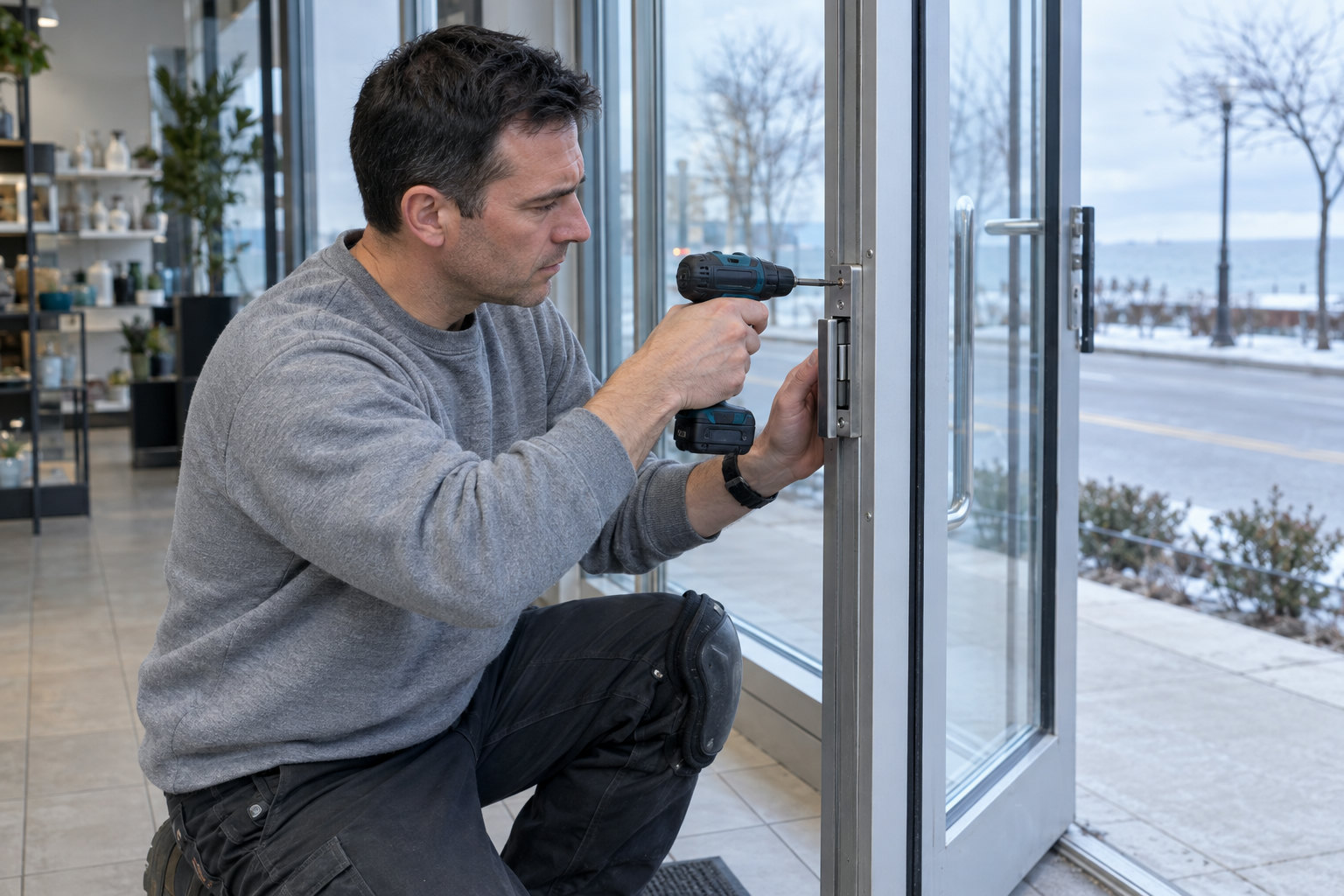
Electric strike vs maglock for a storefront door in Lakeshore Toronto during a power outage comes down to one behavior: a maglock releases the instant power drops, while a fail-secure electric strike keeps the door locked from outside and still lets people walk out from inside. That single difference decides whether a shop stays secured or sits open to the street when the power goes out.
This waterfront strip differs from most of Toronto because its retail runs along one long, exposed corridor: older low-rise buildings on Lake Shore Boulevard West, shops at street level with apartments above, and front doors that take wind, humidity and road salt off Lake Ontario every winter. If you own or manage a café, salon, pharmacy or corner store on the boulevard and someone has proposed a buzz-in or card-reader front door, this is the decision to settle before anything gets drilled.
- A maglock is fail-safe by design: it needs continuous 12 or 24 VDC power to hold, so it releases the moment power fails unless a battery backup keeps it energized.
- A fail-secure electric strike stays locked from outside during a power outage, while the inside lever, knob or panic bar still opens the door mechanically.
- Many electric strikes, including the HES 1006 series from ASSA ABLOY, can be set to fail-safe or fail-secure in the field during installation.
- Maglocks are sold in common holding-force classes of roughly 600 lb and 1,200 lb, but rust, grime or misalignment on the armature plate reduces real-world holding.
- Ontario’s Building Code allows electromagnetic locks on exit doors only under specific conditions, including release on loss of power and on fire alarm activation.
- On a fail-secure storefront door, a high-security key override cylinder from Medeco or Mul-T-Lock is the way in when the power is out.
- The area takes in the former municipalities of Mimico, New Toronto and Long Branch, which merged into the Borough of Etobicoke in 1967 and became part of the City of Toronto in 1998.
- Lake Shore Boulevard West is the main retail spine, lined largely with older low-rise commercial buildings that put shops at grade and residential units above.
- The shoreline sits on Lake Ontario, so street-facing doors deal with lake wind, humidity and winter road salt.
- The 501 Queen streetcar runs along Lake Shore Boulevard West to Long Branch Loop, and GO trains stop at Mimico and Long Branch stations.
- Electricity comes from Toronto Hydro, which publishes a live outage map for the city.
What makes Lakeshore different for an electric strike vs maglock storefront door in a power outage?
The electric strike vs maglock choice plays out differently on this stretch of the waterfront because three conditions push on a storefront door at once: building age, lake weather and a dense run of street-level retail with homes upstairs. Each one changes what a power outage means for the door.
Older commercial buildings were not wired for electrified doors
Mimico, New Toronto and Long Branch grew up as separate towns before joining Etobicoke in 1967, so much of the commercial stock along the boulevard is older low-rise construction. Many of those storefronts now carry replacement aluminum doors set into frames that were never planned for electrified hardware.
That means no conduit to the door, no power transfer hinge and limited room inside a narrow aluminum jamb for a strike body. Getting power to the lock is often the hardest part of the job. It also shapes the choice, because a surface-mounted maglock is easier to wire than a strike cut into a shallow frame.
Lake weather works on the hardware
Lake Ontario sits just south of the boulevard, and storefront doors facing it absorb wind gusts, humidity and the road salt Toronto spreads every winter. Salt and moisture corrode exposed steel, including the face of a maglock armature plate and the keeper of an electric strike.
Freeze-thaw cycles also move aluminum frames. A door that lines up perfectly in September can drag or sag by February, and both lock types are sensitive to alignment.
Mixed-use buildings raise the stakes of an unlocked door
Shops with apartments above often share entrances, electrical service and sometimes stairwells with residential tenants. In some layouts, a storefront door that unlocks during an outage exposes more than the till.
Outages are a real planning factor across the city, not a theory. The December 2013 ice storm left large parts of Toronto without power for days, and lake-driven storms and summer heat events can still knock out Toronto Hydro service for hours at a time.
Older storefront frames along Lake Shore Boulevard West rarely have a ready power path for electrified hardware. Lake wind, humidity and road salt degrade alignment and holding surfaces, and mixed-use buildings make an unlocked front door a bigger exposure during an outage.
What happens to an electric strike or a maglock when the power goes out?
An electric strike vs maglock for a storefront door during a power outage behaves in opposite ways: the maglock unlocks, and a fail-secure strike stays locked. Everything else in the comparison follows from how each device holds the door.
How a maglock behaves in an outage
A maglock (electromagnetic lock) is an electromagnet mounted on the frame header that clamps onto a steel armature plate fixed to the door. It holds only while current flows, typically at 12 or 24 VDC, so it is fail-safe by its nature.
Cut the power and the magnet lets go. Unless a battery backup keeps it energized, the door swings open from both sides. Brands such as Securitron, part of ASSA ABLOY, build maglocks in the common 600 lb and 1,200 lb holding-force classes.
Exit works electrically too. A request-to-exit motion sensor above the door and a push-to-exit button beside it cut power so people can leave, and the lock must also release when the fire alarm activates.
How an electric strike behaves in an outage
An electric strike replaces the fixed strike plate in the frame with a powered keeper that pivots open to release the door’s existing latch. The lockset on the door stays mechanical, which is the key point for outages.
In fail-secure mode, the keeper stays locked when power is lost, so nobody can buzz in from outside. From inside, turning the lever or pushing the panic bar still retracts the latch out of the keeper. Free exit never depends on electricity.
Staff get in with a key. The outside cylinder retracts the latch mechanically, just as it did before the strike was installed.
Fail-safe vs fail-secure, side by side
Fail-safe and fail-secure describe what a lock does on power loss: fail-safe unlocks, fail-secure stays locked. The table below compares the three setups a storefront owner is usually offered.
| Behavior | Maglock | Fail-secure electric strike | Fail-safe electric strike |
|---|---|---|---|
| Outside, during an outage | Unlocked once power or battery is gone | Stays locked; key entry only | Unlocked; latch can be pushed open |
| Exiting from inside | Motion sensor, exit button, fire alarm release | Mechanical lever or panic bar, always | Mechanical lever or panic bar, always |
| Power draw while locked | Continuous | Only while releasing | Continuous |
| Battery backup load | High; drains the battery the whole time it holds | Low; battery mainly powers the reader or intercom | Moderate to high |
| Mechanical key override | None on the lock itself | Yes, via the door’s cylinder | Yes, via the door’s cylinder |
| Best fit | Interior doors, pairs of glass doors, doors that must release on alarm | Street-facing shop doors, buzz-in counters, rear service doors | Doors that must allow free entry on power loss |
| Main weak point | Corrosion and misalignment cut holding force | Preload from wind or weatherstrip can stop release | Outage leaves the door open |
Which lock belongs on which storefront door?
A fail-secure electric strike belongs on a single street-facing shop door where staff buzz customers in, or where the door must stay locked from outside if Toronto Hydro service drops mid-shift. A maglock belongs where the door must release on fire alarm, on interior doors between a sales floor and a stockroom, and on pairs of glass doors with no center mullion.
Pairs of doors are where maglocks earn their place. A double maglock mounts across the header and holds both leaves, while a strike on a pair usually needs a removable mullion or electrified exit devices.
There is a third option that competitors rarely mention. An electrified mortise lock, such as Schlage’s L9000 series in its electrically unlocked (fail-secure) version, puts the electric control inside the door instead of the frame. It suits a door whose frame is too shallow for a strike body, though it needs a power transfer hinge to carry wiring into the door.
One more detail matters for overnight security. An electric strike releases only the latch, so a mechanical deadbolt thrown at closing still holds the door no matter what the power does. A shop that locks a separate deadbolt every night has already made its after-hours outage behavior irrelevant, for either system.
What problems do electrified storefront doors run into on an older retail strip?
Electrified storefront doors on older lakeside retail buildings tend to fail in four predictable ways, and most of them have more to do with the door and the weather than with the lock itself. Each is avoidable when it is planned for at installation.
1. A maglock that holds far less than its rating
A maglock’s 600 lb or 1,200 lb rating assumes full, flat contact between the magnet face and the armature plate. Rust from salty winter air, a film of grime or an armature that no longer sits flush all reduce that contact, and holding force drops with it.
The door still looks locked. It just gives way to a hard pull sooner than expected. Wiping both faces clean and checking that the armature pivots freely on its mounting bolt is basic seasonal maintenance near the lake.
2. An electric strike that will not release under wind load
Electric strikes have a preload limit: the amount of side pressure on the latch that the keeper can overcome while releasing. Wind pressing on a narrow aluminum door, or a stiff new weatherstrip pushing it outward, can exceed that limit so the strike buzzes but the door stays shut.
The fix is usually adjustment, not replacement. A properly set door closer, a keeper position that leaves a small latch gap and a strike model chosen for higher preload all help.
3. Seasonal frame movement throwing off alignment
Aluminum storefront frames expand and contract with temperature swings, and older buildings settle. A latch that drops neatly into a strike keeper in fall can ride its edge in midwinter, and a maglock armature can end up meeting the magnet at an angle.
Sagging hinges and worn pivots are the usual root cause. The same wear patterns show up in purely mechanical hardware, and these signs a door lock needs replacing apply to the lockset behind an electric strike too.
4. Keys and batteries nobody has checked
The backup battery in an access control power supply is a consumable part with a limited service life, and a weak one fails exactly when it is needed. A maglock on a tired battery can hold through a brief flicker and then let go an hour into a longer outage.
Keys are the other blind spot. A common mistake when taking over a storefront lease is leaving the existing cylinder in place: the previous tenant’s keys, and every copy they handed out, still open the key override on a fail-secure door. Rekeying at turnover closes that gap for a small fraction of the cost of replacing the hardware.
How should an electric strike or maglock be installed on a storefront door?
An electric strike or maglock installation on a storefront door should start with the outage decision, not the hardware catalogue. Once the owner knows whether the door must stay locked or release when the power fails, the brand and model choices narrow quickly.
For property managers handling several storefronts in one building, the same sequence keeps every door consistent, which matters when a single outage hits all of them at once.
Identify the door and frame
Narrow-stile aluminum, hollow metal and wood doors each take different strikes and mounting brackets, and frame depth decides whether a strike body fits at all.
Decide outage behavior first
Choose fail-secure (stays locked) or fail-safe (unlocks) for power loss, then pick hardware that delivers it.
Confirm exit and fire alarm requirements
If the door is a required exit, check the Ontario Building Code conditions for electromagnetic locks and whether the lock must tie into the building’s fire alarm.
Match the hardware
HES and Adams Rite strikes suit narrow aluminum frames, Securitron maglocks suit glass pairs, and a Schlage L9000 electrified mortise suits shallow frames.
Plan power and backup
Size the power supply and battery to the lock’s draw; a maglock needs far more battery capacity than a fail-secure strike for the same outage.
Secure the key override
Fit or rekey the outside cylinder, ideally with a restricted-keyway Medeco or Mul-T-Lock cylinder, because it is the only way in during an outage.
Test a real outage before handover
Cut mains power to the lock supply, watch what the door does from both sides, and confirm staff can exit and re-enter.
Brands that fit lakeside conditions
ASSA ABLOY owns several of the brands used on electrified storefronts: HES and Adams Rite for strikes, Securitron for maglocks, and Medeco and Mul-T-Lock for high-security cylinders. Schlage, part of Allegion, offers its L9000 mortise lock in electrified fail-safe and fail-secure versions.
Near salt air, finish matters as much as brand. Stainless steel strike faces and corrosion-resistant armature plating hold up better than bare or lightly plated steel on a door facing the boulevard.
Etobicoke Locksmith‘s uniformed mobile technicians work on storefronts across the area, as well as Mississauga. The visit follows the same pattern as any commercial job, and this walkthrough of what happens during a professional lock installation shows the on-site steps. For a shop whose front door has already been attacked, this account of a café front door lock rebuilt after drilling covers the mechanical side.
One caution about quoting. A common mistake is accepting a flat phone quote for an electrified door conversion: the real scope depends on the frame, the wiring path and an on-site assessment, so a reputable locksmith quotes after seeing the door. Contact the shop directly for pricing on your specific door.
Our view
This is opinion, plainly labelled. For a typical street-level shop door, a fail-secure electric strike paired with a mechanical lever and a high-security key cylinder is the better default answer to the electric strike vs maglock question for a storefront door in a power outage. It keeps the door locked from outside, keeps exit mechanical and leaves a key path in when everything electrical is dead.
Maglocks tend to be overweighted because they are simple to mount on glass and have no moving parts. Those are real strengths, but on an exterior shop door they move the security burden onto a battery, a motion sensor and clean contact surfaces, all of which degrade in salt air.
What actually matters is less exotic. A sound door, a frame that stays aligned through winter, a cylinder that only current staff can operate and a test of the outage behavior before it is needed will do more for a shop than any single lock model.
Frequently asked questions
Does a maglock unlock when the power goes out?
A maglock unlocks when the power goes out because it needs continuous 12 or 24 VDC current to hold the armature plate. The only way to keep it locked through an outage is a battery backup in the power supply, and it releases once that battery runs down.
Can an electric strike be switched between fail-safe and fail-secure?
Many electric strikes can be switched between fail-safe and fail-secure during installation, including the HES 1006 series from ASSA ABLOY. Other models are built in one mode only, so confirm the setting on the strike itself rather than assuming it from the box.
Can people still get out of a fail-secure door during a blackout?
People can still get out of a fail-secure electric strike door during a blackout, because the inside lever or panic bar retracts the latch mechanically. Fail-secure only describes the outside, which stays locked until a key or restored power releases it.
How long will a battery backup keep a maglock locked?
Battery backup runtime for a maglock equals the battery’s amp-hour capacity divided by the lock’s continuous current draw, plus the draw of any reader or sensor on the same supply. Power supplies from makers such as Altronix list these figures, and batteries lose capacity with age, so the calculation should be rechecked whenever the battery is replaced.
Sources
- Conditions for electromagnetic locks and door release hardware on exit doors: Ontario Building Code, O. Reg. 332/12 (Ontario e-Laws)
- Maintenance of exits and fire safety requirements in existing buildings: Ontario Fire Code, O. Reg. 213/07 (Ontario e-Laws)
- Electricity supply and live outage information for Toronto: Toronto Hydro
- Brand ownership of HES, Securitron, Adams Rite, Medeco and Mul-T-Lock: ASSA ABLOY
Etobicoke Locksmith
 Listen to this articleAudio version
- A Lakeshore Customer Asked: “If My Key Turns but the Door Won’t Open, Should I Force It?”
- How a Lakeshore Toronto Retail Unit’s ASSA Abloy Lock Cylinder Failed During a Sunday Opening — and What We Found
- What Happens When We Install a Smart Lock on a Queensway Condo Door — The 11-Step Process
- New Toronto Rental Units Have a Specific Door Frame Issue That Makes Standard Deadbolts Unreliable
- The New Toronto Café Owner Whose Front Door Lock Was Drilled Out Overnight — How We Rebuilt the Entryway